CSIA Poll Insights | Board Effectiveness & Strategic Resilience
In an increasingly unpredictable business environment, board effectiveness has never been more critical. From geopolitical uncertainty and technological advancements to economic volatility and evolving stakeholder expectations, boards are under growing pressure to make informed decisions, anticipate risks and guide their organisations through continuous disruption.
But what is the biggest obstacle preventing boards from operating effectively in this environment?
A recent poll conducted by the Corporate Secretaries International Association (CSIA) asked governance professionals:
“What is the biggest barrier to board effectiveness in an era of continuous disruption?”
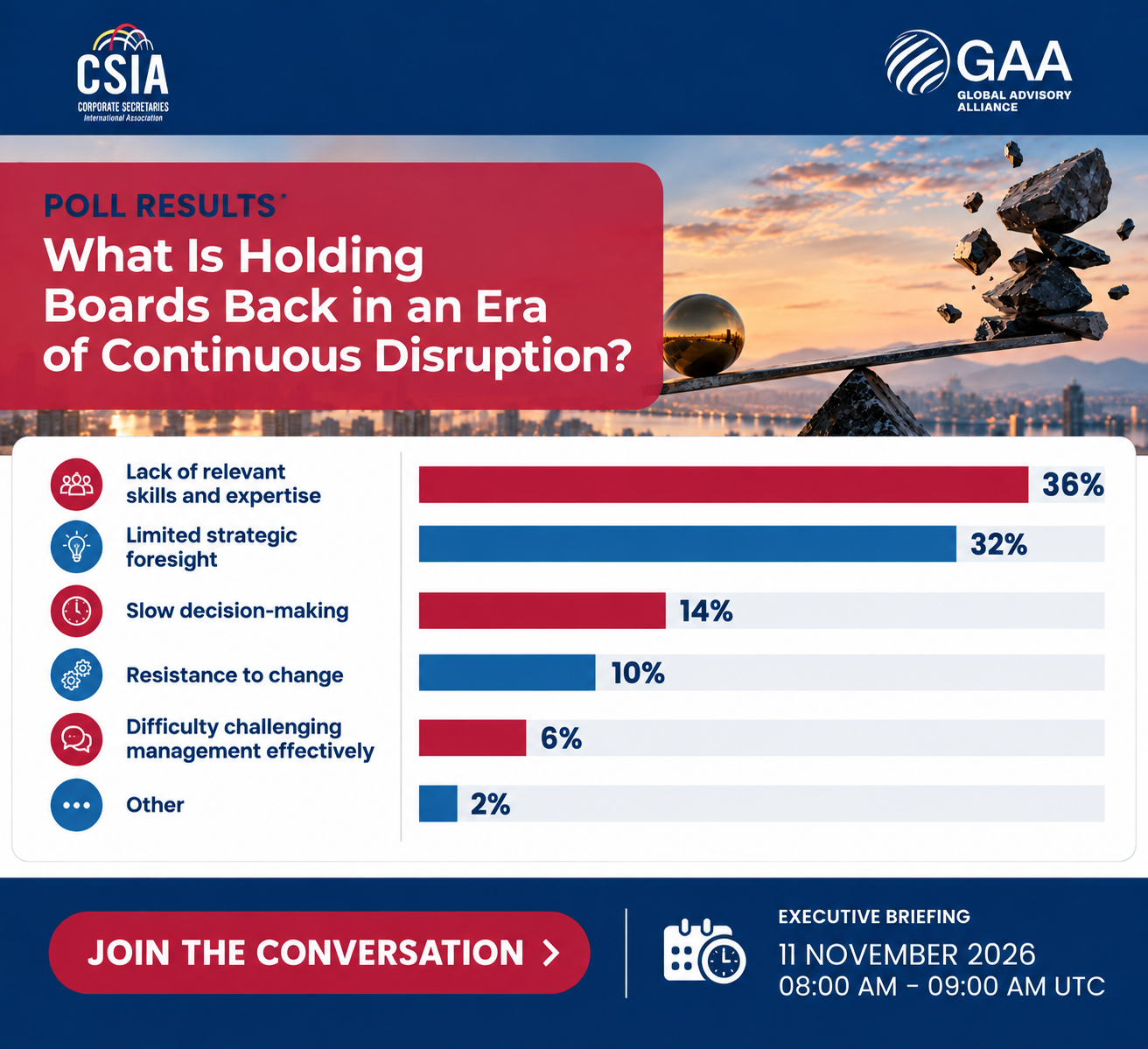
The results reveal two significant concerns: a lack of relevant skills and expertise, and limited strategic foresight.
These findings highlight the importance of equipping boards with the capabilities, perspectives and adaptability needed to navigate uncertainty.
Corporate secretaries have an important role in translating these priorities into effective governance practice. By advising the board on governance processes, supporting the flow of timely and relevant information, and helping ensure that decisions, risks and follow-up actions are properly documented, they can help boards remain focused, informed and accountable as conditions change.
What the Poll Results Reveal
The poll highlighted several perceived barriers to board effectiveness, with skills gaps and strategic foresight emerging as the most significant concerns.
Barrier to Board Effectiveness | Percentage |
Lack of relevant skills and expertise | 36% |
Limited strategic foresight | 32% |
Slow decision-making | 14% |
Resistance to change | 10% |
Difficulty challenging management effectively | 6% |
Other | 2% |
Percentages represent the proportion of all answers submitted, rather than the proportion of individual respondents.
Together, lack of relevant skills and expertise (36%) and limited strategic foresight (32%) accounted for 68% of all responses, suggesting that governance professionals see board capability and forward-looking leadership as particularly important challenges.
While these findings provide a snapshot of respondents’ perspectives rather than a comprehensive industry study, they raise important questions about how boards must evolve to remain effective.
Bridging the Board Skills Gap
With 36% of responses identifying a lack of relevant skills and expertise as the biggest barrier, the poll highlights concerns about whether boards possess the capabilities required to navigate an increasingly complex business landscape.
Today’s boards must oversee issues that extend far beyond traditional financial and compliance responsibilities. Artificial intelligence, cybersecurity, sustainability, digital transformation and geopolitical developments all demand informed oversight and sound judgement.
As these challenges evolve, so too must board composition, professional development and access to specialised expertise.
The question for boards is no longer simply whether they have the right expertise today, but whether they are preparing for the challenges of tomorrow.
Regular board evaluations, targeted development programmes and a commitment to continuous learning can help organisations identify capability gaps and strengthen governance effectiveness.
The corporate secretary can help facilitate this work by supporting board and committee evaluations, identifying governance-related development needs, and helping directors access the information and learning required to oversee emerging issues. Working with the chair and relevant stakeholders, the corporate secretary can also help ensure that board composition, induction and ongoing development remain aligned with the organisation’s evolving risk and strategic environment.
Strengthening Strategic Foresight
Limited strategic foresight emerged as the second-largest concern, accounting for 32% of responses.
In an era of continuous disruption, boards cannot rely solely on historical performance or established strategic assumptions to guide future decisions.
Effective governance increasingly requires the ability to anticipate emerging risks, recognise opportunities and consider multiple possible futures.
Strategic foresight does not mean predicting every disruption. Rather, it involves developing the capacity to identify early signals of change, challenge existing assumptions and prepare organisations to respond effectively.
Boards that integrate scenario planning, emerging-risk discussions and long-term strategic thinking into their governance practices may be better positioned to build organisational resilience.
The corporate secretary can support strategic foresight by helping shape board and committee agendas so that emerging risks, external developments and longer-term scenarios receive appropriate attention—not only when a crisis occurs. They can also help ensure that board papers clearly distinguish immediate operational issues from matters requiring strategic consideration, and that key decisions and agreed actions are tracked over time.
The challenge is to move beyond reacting to disruption and towards preparing for it.
Balancing Effective Decision-Making with Agility
Slow decision-making accounted for 14% of responses, while resistance to change represented a further 10%.
Although these barriers received fewer responses than skills gaps and strategic foresight, they highlight another important dimension of board effectiveness: the ability to act decisively while maintaining robust governance.
During periods of uncertainty, boards must often make decisions with incomplete information, competing priorities and rapidly changing circumstances.
Excessive caution can delay necessary action, while decisions made without sufficient scrutiny may expose organisations to unnecessary risk.
The most effective boards must therefore strike a balance between sound governance and strategic agility, ensuring that decision-making processes support both accountability and responsiveness.
Developing a culture of constructive debate, openness to new perspectives and adaptability can help boards navigate this balance.
In this context, the corporate secretary helps create the conditions for timely, well-governed decisions. Clear agendas, concise and decision-focused papers, accurate minutes and reliable action tracking can support efficient discussion while preserving a record of the board’s reasoning, challenge and oversight. The corporate secretary’s governance advice can also help the board understand relevant procedural and compliance considerations without losing sight of the need to respond with agility.
Encouraging Constructive Challenge and Independent Thinking
A further 6% of responses identified difficulty challenging management effectively as a barrier.
Although this represented a smaller proportion of responses, constructive challenge remains a fundamental component of effective board oversight.
Boards must be able to question assumptions, evaluate management proposals and provide independent perspectives without creating unnecessary conflict or slowing organisational progress.
An environment that encourages open dialogue, diverse viewpoints and respectful challenge can strengthen decision-making and reinforce accountability.
In times of disruption, the ability to ask difficult questions may be just as important as having the expertise to answer them.
The Corporate Secretary: Connecting Governance and Resilience
The poll did not ask respondents specifically about the corporate secretary’s role, but its findings point to governance challenges where that role can make a practical contribution.
As a governance adviser and a key link between the board, management and governance processes, the corporate secretary can help the board turn insight into disciplined action. This includes supporting effective agendas and information flows, facilitating board evaluations and development, helping directors stay alert to emerging governance and regulatory expectations, and maintaining clear records of decisions, responsibilities and follow-up.
The corporate secretary does not replace the board’s responsibility for strategy or management’s responsibility for running the organisation. Rather, the role helps the board discharge its responsibilities effectively by strengthening the processes, information and accountability that underpin good decision-making. During continuous disruption, this contribution can help governance remain both robust and adaptable.
For corporate secretaries, the poll is therefore a prompt to look beyond procedural compliance and consider how governance support can help the board build capability, think ahead, make timely decisions and encourage constructive challenge.
The corporate secretary can help enable this constructive challenge by supporting an orderly and inclusive board process, ensuring that directors have opportunities to raise questions, and recording material points of discussion and decisions accurately. In partnership with the chair, the role can help sustain a board culture in which respectful challenge strengthens accountability rather than becoming a barrier to progress.
From Insight to Action: Rethinking Board Effectiveness
The poll findings point towards a broader governance challenge.
Board effectiveness can no longer be measured solely through compliance, established procedures or traditional governance structures. It must also reflect a board’s ability to anticipate change, exercise sound judgement and provide strategic direction in uncertain conditions.
For governance professionals, this raises several important considerations:
- Are boards equipped with the skills and expertise needed to address emerging challenges?
- How effectively are boards anticipating future risks and opportunities?
- Do existing governance structures enable timely, informed decision-making?
- Are board cultures encouraging constructive challenge, adaptability and continuous learning?
Addressing these questions is essential to strengthening board resilience and ensuring that governance practices remain relevant in a rapidly changing world.