
As boards face growing scrutiny from regulators, shareholders, and the public, the traditional parameters of board evaluations are being redefined. Once focused primarily on compliance, financial oversight, and procedural performance, today’s governance environment demands a broader, more adaptive form of leadership.
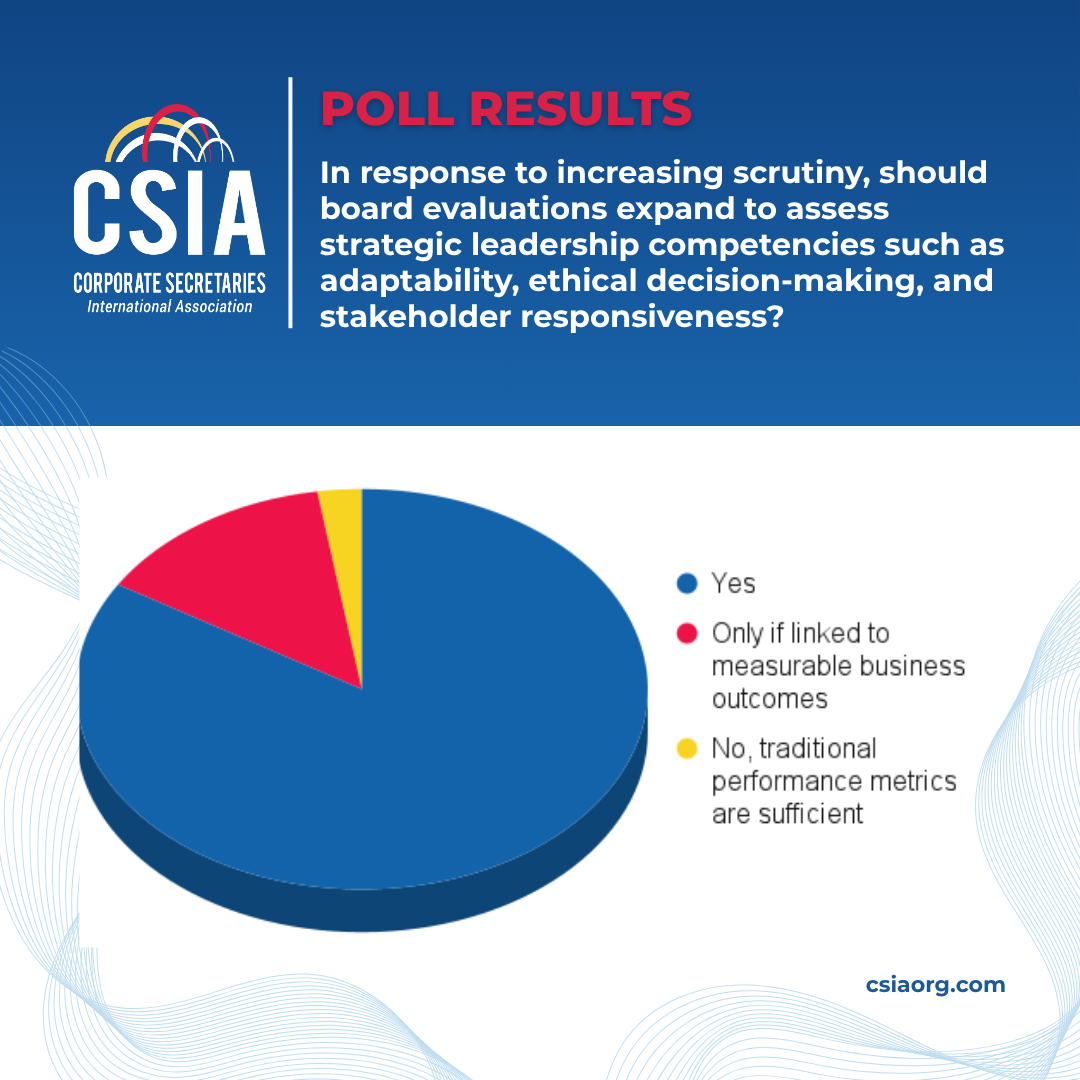
In our recent CSIA poll, an overwhelming 83.75% of respondents agreed that board evaluations should expand to assess strategic leadership competencies such as adaptability, ethical decision-making, and stakeholder responsiveness. Only 13.75% believed this should happen only if linked to measurable business outcomes, while a mere 2.5% felt that traditional performance metrics remain sufficient.
These results reflect a powerful consensus: boards are expected to lead with purpose and foresight, not just accountability.
The Expanding Scope of Board Evaluations
Board evaluations have historically centred on governance compliance, structure, and process. However, as the global governance landscape evolves, boards are increasingly judged by their ability to navigate complexity, anticipate change, and uphold ethical integrity.
Competencies such as adaptability, ethical foresight, and stakeholder responsiveness are no longer optional — they are essential indicators of a board’s ability to sustain long-term value creation and public trust.
From Performance to Purpose
This shift signals a movement from measuring “what boards do” to understanding “how they lead.” Strategic leadership qualities—such as guiding corporate culture, fostering diversity of thought, and maintaining agility in the face of disruption—are central to governance excellence in the modern era.
By incorporating these dimensions into formal evaluations, organisations can ensure that leadership effectiveness is aligned with their broader purpose and stakeholder expectations.
A New Era of Governance Accountability
The overwhelming response to this poll highlights a collective awareness that governance excellence extends beyond compliance. Boards that proactively adapt evaluation frameworks to include leadership behaviours and ethical competencies are better equipped to build resilient, future-ready organisations.