
As organisations become increasingly interconnected across markets, technologies and jurisdictions, geopolitical developments are becoming more closely intertwined with corporate governance. Boards and governance professionals are being asked to consider risks that extend well beyond traditional organisational boundaries – from cyber threats and regulatory change to international trade tensions and supply chain disruption.
A recent CSIA poll asked:
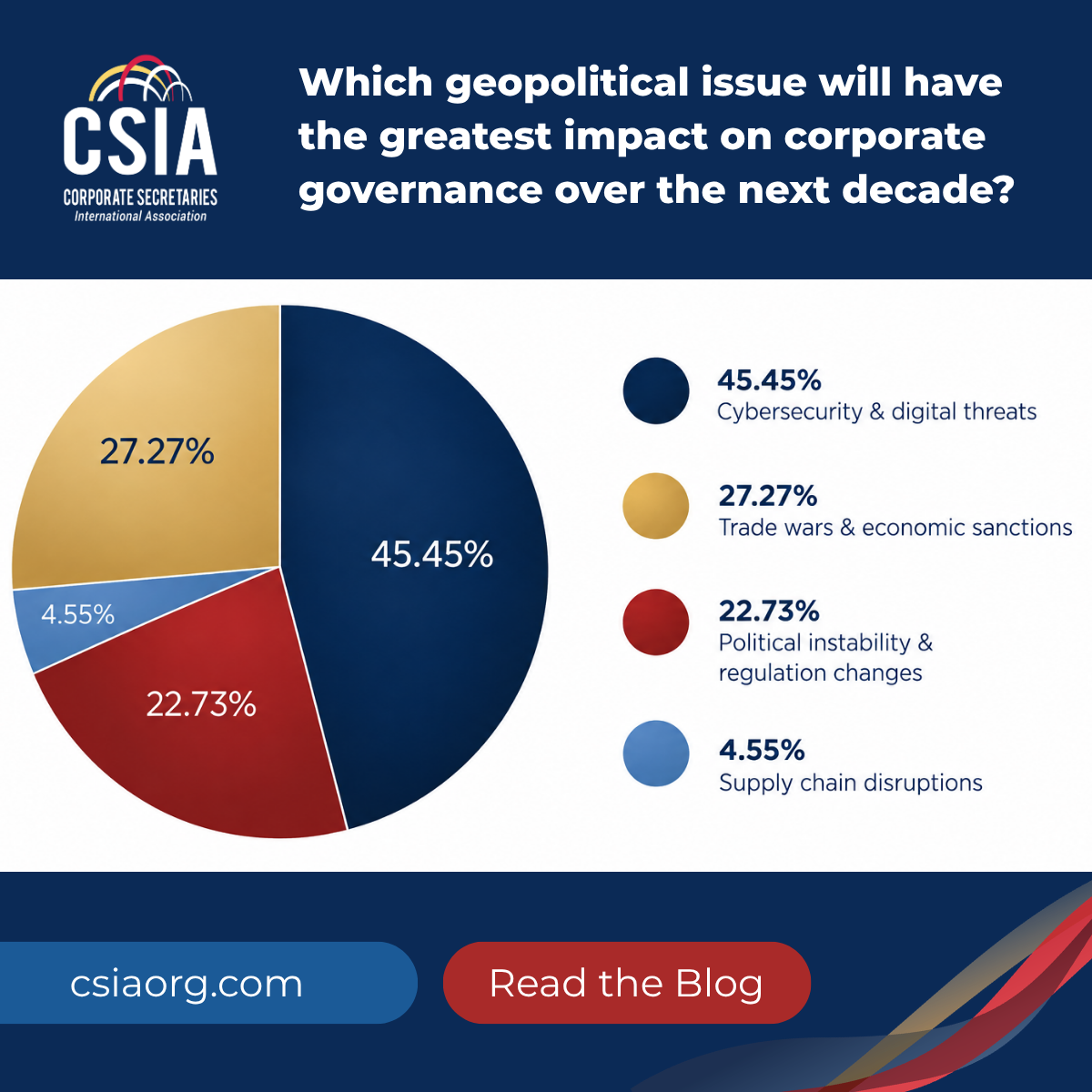
“Which geopolitical issue will have the greatest impact on corporate governance over the next decade?”
The results reveal a particularly strong concern around the rapidly evolving digital risk landscape.
Cybersecurity and digital threats lead the results
Cybersecurity and digital threats emerged as the leading concern, selected by 45.45% of respondents.
The result reflects the growing relevance of technology-related risk to board oversight. As organisations become more dependent on digital infrastructure, data and interconnected systems, cybersecurity increasingly intersects with areas such as risk management, business continuity, regulatory compliance, reputation and organisational resilience.
For boards, this raises important governance questions. Do directors receive sufficient information to understand the organisation’s digital risk exposure? Are responsibilities for cybersecurity clearly defined? And does the board have access to the expertise needed to provide meaningful oversight?
Cybersecurity can no longer be viewed solely as a technical matter. Within the governance environment, it is increasingly a strategic issue requiring informed and ongoing board attention.
Trade tensions introduce another layer of uncertainty
Trade wars and economic sanctions received 27.27% of responses, making them the second most selected issue.
For organisations operating across jurisdictions, changes in international trade relationships can create new considerations around compliance, market access, suppliers and strategic investment. Sanctions regimes and changing trade requirements may also require organisations to reassess existing relationships and strengthen the processes through which geopolitical developments are identified and communicated to decision-makers.
The result reinforces the importance of boards maintaining an outward-looking perspective. Governance decisions increasingly need to account not only for conditions within an organisation’s home market, but also for developments occurring throughout its international network.
Political instability and regulatory change remain significant
A further 22.73% of respondents identified political instability and regulation changes as the geopolitical issue they believe will have the greatest impact on corporate governance.
Changing political and regulatory environments can create complex challenges for organisations, particularly those operating across multiple jurisdictions. New reporting requirements, governance standards and regulatory expectations may require organisations to adapt policies and oversight structures as circumstances evolve.
For governance professionals, keeping boards informed of relevant regulatory developments and their potential organisational implications remains an important part of supporting effective decision-making.
Supply chain disruption receives a smaller share
Supply chain disruptions accounted for 4.55% of responses.
Although it received the smallest share of this particular poll, supply chain resilience remains connected to many of the other issues identified by respondents. Trade restrictions, geopolitical tensions, regulatory developments and cyber incidents can all affect complex international supply networks.
This interconnectedness demonstrates why geopolitical risks cannot always be considered independently. A development in one area can quickly create consequences elsewhere, requiring boards to consider both immediate impacts and wider organisational dependencies.
From geopolitical awareness to governance preparedness
Taken together, the results highlight an increasingly important reality for boards: geopolitical developments are becoming governance issues.
While cybersecurity and digital threats stood out most strongly among respondents, the poll also points to a broader environment in which technological, political, economic and regulatory risks frequently overlap.
For boards, effective oversight in this environment may require stronger horizon scanning, scenario planning and access to specialist expertise. Governance professionals can play an important role by helping boards identify emerging developments, understand their relevance and ensure they are incorporated into strategic and risk discussions.
How prepared is your board for the geopolitical risks of the next decade?
As the external environment continues to evolve, strong governance will increasingly depend on the ability to look beyond immediate challenges, anticipate emerging risks and ensure that boards have the information, perspectives and expertise required to navigate uncertainty.
For CSIA and its global network, sharing knowledge and experiences across jurisdictions provides an important opportunity to strengthen this understanding – helping governance professionals remain connected, informed and prepared for the challenges ahead.